Showing posts with label journal prompts. Show all posts

Tuesday, October 22, 2013

Pictures and words

There’s a reason why they say that a picture is worth a thousand words. I’ve found that using visual art is a great way to launch a conversation, inspire writing, and teach analytical thinking. 

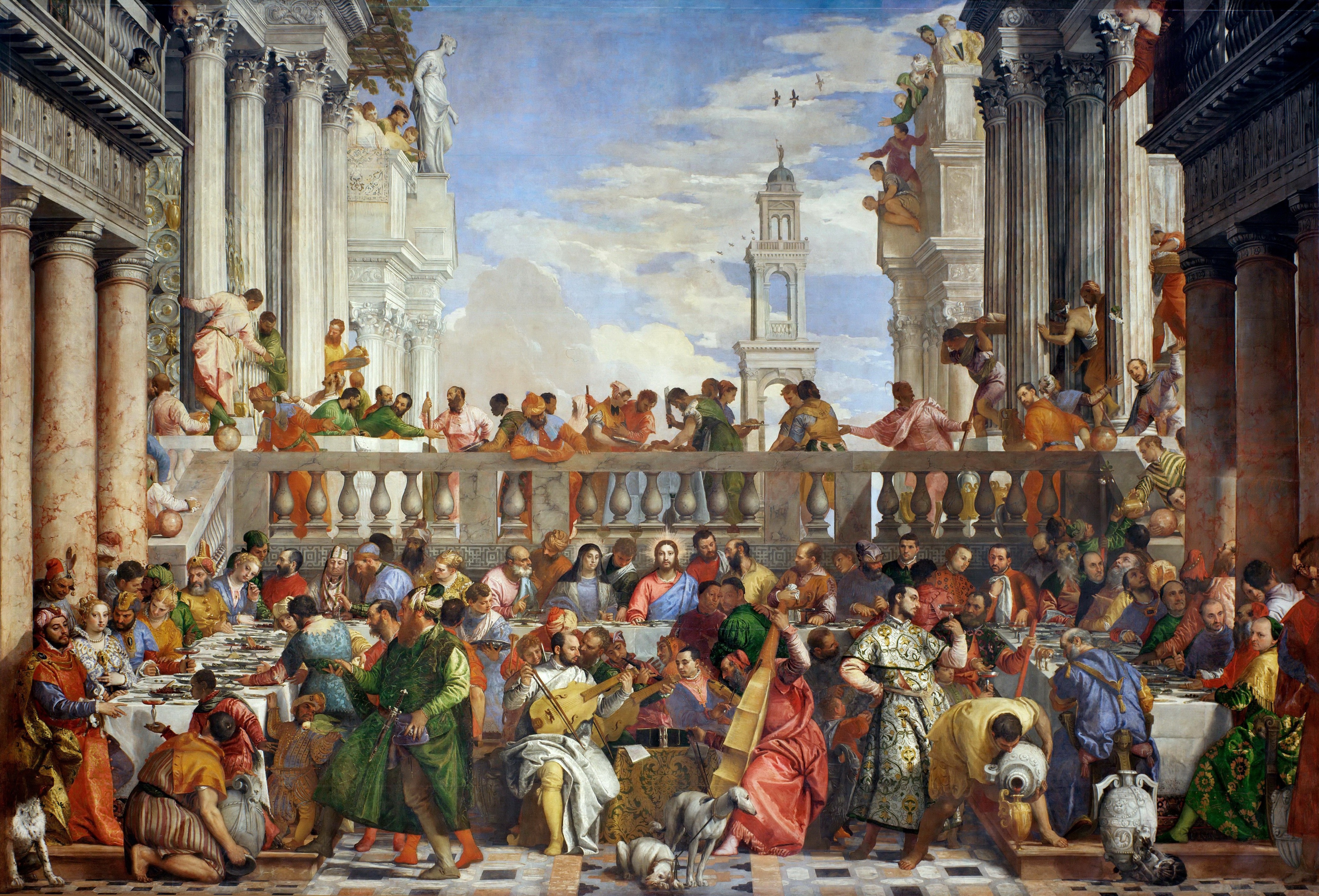
Find a photograph or painting with a lot going on in the way of action and/or facial expressions. National Geographic has tons of great photos to download and print, or just to look at. Art books are nice (you can get them at the library) if you want something bigger.

Here are some pieces that I like:
Bruegel the Elder: The Dutch Proverbs

I ended up sticking with Western art simply because that’s what I’ve been able to find the most of. There are plenty of very cool Asian, Native American, South American and African art pieces with lots of detail and action, but it seems that expressive crowd scenes with high pixelation are the domain of European artists. Haven’t given up, though. Also, here's where art books from the library come in handy. Yay, libraries.

Veronese's Wedding at Cana. Thanks, Wikipedia.

There’s so much you can do. Here are a few ideas to start with:
  • Take turns describing what you see: observe details like colors, textures, light and shade, in addition to what is actually happening. 
  • Make up a title (best if you don’t show your student the title first). Make up titles for different parts of the scene if there is a lot going on. 
  • If you want, you can play a grammar game: list the verbs you see happening. List the nouns, and then the adjectives that describe them. List the adverbs. 
  • Describe imagined details: sounds, smells, sensations, tastes.
  • Make up a story about one person, about the whole scene...pick one interaction and tell what has happened just before the moment in the painting, and what will happen in the next moment(s). 


More on what to do with art coming soon.

Friday, July 12, 2013

Celebrity Fashion Disasters as Writing Prompts

As promised in the last post, I tried out the "let's make snide comments about celebrities and their dresses" idea with Tai. Results are in and they are mixed. I didn't see the kind of voice, humor, and...liveliness that I was hoping for--a lot of his comments were literal and obvious--but hey, he's a beginner, it was fun and I think there's potential for development here.

For your viewing pleasure, I've included some of the pix and commentary in this post; click here to see the whole slide show. We skipped a few that either didn't inspire or that we actually liked. For example:

courtesy of heart.com.uk

I love that Tai thought the jacket was just fine. And now without further ado, Tai's commentary on celebrity fashion disasters:


Lucy Liu:
She looks like a rose garden. Photo courtesy of nowmagazine.com.uk


Lady Gaga:
She looks like a woman canible [sic]. Photo courtesy of inblive.in.com


Someone I've never heard of:
She is a pink centaur. Photo courtesy of beautyhaven.com.au

Someone else:
She is wearing wallpaper. Photo courtesy of reviews.in.88db.com


Justin Bieber: 
A minion in a construction helmet. Photo courtesy of thegloss.com

and Beyonce:
A volcano! Photo courtesy of girlstalkinsmack.com

Friday, June 14, 2013

Fathers' Day List Activity

Sort of a journal activity, in the list genre.

What makes Dad, Dad? That is to say, what's special about your dad? Some ideas:

What is special about Dad?
What do you love (or like) best about Dad?
What does Dad do that makes you laugh?
What is Dad good at?
What is Dad bad at? (as long as this is affectionate)
What do you enjoy doing with Dad?
What has Dad taught you to do?

Go for 10 sentences.
Brush it up--check grammar, spelling, etc.
Make it pretty--make a card, write it in calligraphy, type it on the computer and play with fonts and colors, draw a picture.

Happy Fathers' Day!


Friday, May 24, 2013

Journal Prompt: Alphabet Stories

Background
I got this idea over a decade ago from a Japanese friend of mine. I'm sure it's been done before in the U.S., but I haven't seen it in my (admittedly limited) personal library of books about writing with kids.

My friend told me about a story she'd written when she was a little girl, and it went through the alphabet, starting with a king (Aiue-Oosama, or King Aiue. The first five letters of the Japanese alphabet are A, I, U, E, and O). It was very clever, and I've always wanted to try something like it.

The prompt
This is probably better for upper elementary kids and older. It can be a quick writing prompt or it could become a more finished piece, like a book:

Write a story or a paragraph about anything, in which every sentence starts with a letter of the alphabet, starting with A and working your way through to Z.

I gave Tai the prompt and said I'd do it too. Tai sat and happily wrote twenty-six sentences—more than he's ever done in one sitting in his life. I could hardly believe it. It might be the longest thing he's ever written.

Why it works
I think this worked because it helped him to focus on just one sentence at a time (bird by bird, as it were), instead of a whole idea. The letter challenge gave him an excuse to be less than perfect, and move on. That is, he didn't get bogged down trying to convey his very abstract thinking or create a complex narrative; all he had to do to meet the challenge was think of a sentence that started with the appropriate letter and that sort of worked with his theme.

Another possible reason: Of course, he wanted to see what I wrote right away, and compare. My own sentences weren't great, and they were silly. I'm sure he thought, “I can do better than that,” which always motivates him.

Variations
  • Take turns. One person writes a sentence for one letter, the next person writes a sentence for the next letter, etc.
  • Drop the idea of a narrative frame or a paragraph; just make a list of sentences.
  • Or keep the frame and simply require one word somewhere in the sentence to start with the alphabet letter.
  • Just make a list of words. Or if you're working with grammar, a list of verbs. Or adjectives. Or proper nouns. I did it with adjectives once, because Tai could not remember what they were and how they worked. Thinking of twenty-six helped him.  
  • Revising and adding illustrations could make this into a fun book.
  • I think there must be lots of other ways to play with this idea—elaborate or simplify as you please.

Thursday, April 25, 2013

Seven Nonfiction Journal Prompts That Work

So I tried one of the "one morning I woke up" jumpstart prompts with Tai last week and it kind of bombed. The "design  your own school" prompt worked well in September, but "I woke up as small as a mouse"--not so much. "Um," he said tentatively, "Can I just write about what I did on clonewarsadventures.com?"

Well, okay.

I'm not giving up on the mouse prompt. But if you have a kid who does not particularly like to make up fanciful stories, here are some non-fiction options. Tai used to rely on option 5 last year, and now he loves options number 1 and 2.
  1. Write about your latest exploits in the game you played today. What are your hopes/plans/goals for the next time you play?
  2. What did you build in Minecraft today? How did you do it? What are you planning next?
  3. Pick a few useful/important/cool game items and explain why they are important/useful/cool.
  4. Pick a few interesting/important/cool objects from a favorite game, movie, story, etc. and describe them as if for a DK Encyclopedia. (one sentence per item is fine, if there are four or five items. One item with four or five sentences is even better!) Drawing them is okay, but it extends the writing time.]
  5. Draw a spaceship (or car, or bike, or whatever) with special features and capabilities. Label and explain their uses.
  6. Draw a castle, (palace, fort, fairy dwelling, space station, house) with whatever special features you like. Label and explain.
  7. Draw a map of the room you would love to have, including colors, magic portals, hidden weapons caches, and explain what you've drawn. Label and explain.
One variation--which Tai came up with, bless his heart--would be to respond to prompt #1 in the voice of your child's online avatar. Or the avatar's arch-enemy! Great practice with voice and point of view.


Thursday, April 18, 2013

Jumpstart Journal Prompts: Schedules

    Sometimes even a jump start isn't enough. I got the idea for schedules from Peggy Kaye's Games for Writing. You can try using a schedule as a framework for the “one morning I woke up” prompts—this way kids can “schedule” plot points, which is sometimes easier than writing a continuous narrative. The schedule should count as the journal entry, even if your child doesn't use complete sentences. Here's an example from the “day of whatever I want to do” prompt:
  • One night, Dad told me that I would be allowed to spend the next day doing exactly what I wanted to. The next morning, I woke up at x:00 a.m. I was so excited! Here's what I did:
8:00                                                            9:00
10:00
11:00
12:00
1:00
2:00
3:00
4:00
5:00
6:00
7:00
8:00

  • I tried this with Tai, and it worked well. I did my own at the same time, which also worked well. Makes for a nice jumping off point for a discussion of favorite activities. 
  • Or--and I haven't tried this--have your writer make a schedule of what you think you would do with your day. And you can do one for her. Good exercise in empathy.

The schedule format can be massaged to fit the writer's needs and abilities—half-hour increments, less time, more time...kids can spend more than one hour doing things, too—they don't need to do 12 different things. But I think it makes sense to shoot for at least 8.

Friday, April 12, 2013

Ten Jumpstart Journal Prompts: This morning when I woke up...

These prompts generally lead to narratives. They offer wish fulfillment, exercises in empathy, opportunities for creativity, and some practice with narrative structure.

My own child often claims that he can't think of anything to write about, even when I offer him what I think is a fun prompt. So I sometimes offer a few (too many?) “jump start sentences” to help him get going:
  1. My mom woke me up this morning and handed me the phone. It was the president of Cool Homes for Kids. He said that my mom had put my name in a lottery and I had won it! The company would give me as much money as I needed to build any kind of house I liked, anywhere in the world. Wow. I said thanks, and hung up the phone. I began to plan my house. First...
  2. This morning I woke up in a huge dark cave. The walls were soft, like cloth. As I made my way out, I realized with a shock that I was still in my bed—but I had shrunk down to the size of a mouse! What would I do? This could be good, or this could be bad. What would Dad say when he saw me—or didn't see me? Would I be able to speak to him?
  3. When I woke up this morning, I was not in my bed. I was curled up on the floor, and as I began to get up, I saw furry paws where my hands should have been. I straightened my legs, but my hands (paws) didn't leave the ground—and I was only as tall as [your dog or cat's name]. Oh, wow. This could be good, or this could be bad. And where was my body?
  4. When I woke up this morning and pulled the covers off, the covers seemed to move by themselves—and there was nothing underneath them! I stared. I knew my legs were right there, but I didn't see them. I looked at my arm. I saw nothing. I was invisible! Wow. This could be very cool. Or it could be pretty bad.
  5. One night, Dad told me that I would be allowed to spend the next day doing exactly what I wanted to. The next morning, I woke up at x:00 a.m. I was so excited to start my day!
5 more possibilities:
  1. I was [another member of the family].
  2. I woke up on the ceiling—gravity didn't work for me anymore.
  3. I was a stuffed animal. (Is the “real” kid still there? Are the other toys alive?)
  4. I was in the far distant future (or past). (Include a couple of details to get your writer started.)
  5. I was on another planet. (Include a couple of details to get your writer started.)

I haven't tried all of these, so I can't vouch for them 100%. But that's kind of the way it is with any prompt and any kid, right? 

Comments, ideas, variations or suggestions are always welcome.

Friday, March 22, 2013

Seven Minute Journaling

All good writer say--and I also believe--that the only way to get better at writing is to write. There are lots of games you can play together to help a writer emerge, and to make writing a playful rather than painful process—but ultimately, fluency comes from practice. Lots of it. Putting words on the paper or screen on demand gets easier only if you do it often. And sometimes that's hard and painful. But there are ways to make it easier. And it's good practice.

The idea is to write without stopping, without correcting, without really even thinking twice about what gets put on the paper for seven minutes. It's important for this to be a regular practice—three or four times per week, no matter what. Because otherwise it's not a practice, amirite?

This is great practice for perfectionists like mine, who cannot get started for fear of making a mistake, or because they hate to see the purity of their vision ruined by their clumsy attempt to express it. (More on that another time.) It is also good practice for kids whose brains take a while to warm up. Heck, it's great practice for anyone. Which is not to say it's easy, because it's not. It's hard. And sometimes painful. So with that in mind:

Ways to Make it Easier so that you won't have a full-scale mutiny on your hands:
  • Seven minutes can seem like an eternity if you're doing something you don't like or feel like you can't do, so for Tai, I started lower. Five minutes. (Two or three could even work, I guess) Then after a while, we made it a goal to write for six, and worked our way up. (What a great way to model goal setting!)
    • But they have to try to write pretty constantly—it doesn't count if they sit and stare at the screen/paper for two minutes and then write a few words in the last 30 seconds. 
    • Quite frankly, 
  • Another way that sometimes makes things a little easier for Tai is to first draw something that represents what I've asked them to write--or choose something to draw and write about it. This will gave him something to write from. It's like brainstorming ideas. Tai used to like to draw spaceships and then write about each special feature. He created pages that looked sort of like those DK Encyclopedias. It wasn't paragraphs, or even full sentences sometimes, but it was writing. And great practice for writing informational text, actually.
  • Sometimes I have Tai make lists: top ten movies; dream jobs; foods he loves; foods he wishes were as healthy as vegetables; things that are orange; words that start with the letter "L"; things that smell better than they taste; everything they can see/hear/smell/taste from their chair; tv shows, movies, or games that he wishes he could inhabit...
    • Some lists have more potential than others: Tai's list of movies was three items long.
    • More fluent writers can add details, or reasons for each item on their list.
    • The great things about lists is that you can use them later for longer pieces—they can incorporate a list of details into a descriptive piece; they can choose one or two items from a list to serve as jumping-off points for a story or an opinion piece; they can just practice adding details to each list item.
  • Sometimes Tai needs a sentence or two to get started. Provide your writer with one: “This morning I woke up in a strange bed. It was egg-shaped, with covers like cotton. I looked out the window and the sky was green.” 
  • Sometimes the wording of the prompt makes a difference. “Tell about an exciting day you had this week” is so vague. “Make a list of everything you wish you could eat for each meal today”  is much easier to manage.
    • Speaking of prompts, there are a lot of websites out there with long lists of prompts which, quite frankly, I think are not very effective. So another post later with effective prompts, and good resources for prompts.
  • Try to have prompts prepared ahead of time. That way you're more likely to have an effective one. Don't be afraid to re-use a good one, and don't be offended if your writer doesn't like the one you've created/chosen. Maybe have a couple ready just in case.
Did I mention that this is good practice? And that it might be hard? Your writer may balk and whine and protest. Mine did. Let them (gently and kindly). Tell them (gently and kindly) to write their protests on the page. They will most likely not want to. But they might present you with a paragraph detailing just how miserable they are, and how monstrous you are. If they say that they cannot write a single thing, then let them write “I don't know what to write” or “blahblahblah” or “I hate this” over and over. It could be torture for you--I still end up resorting to naggery when I see that that resentful/catatonic stare, or a list of "blah" on the page--but maybe you can turn it into an experiment: how days will this happen before your writer can think of something to say?

I can hear people thinking, “But making a kid write will just make her hate writing even more.” Which, to be honest, I sometimes think myself. But I've been finding that it has not made my writer hate writing. In fact, it has been getting easier and easier over the months that we've done this. Tai isn't writing more, or better necessarily. (Whatever "better" means) But he is writing more fluently.