Showing posts with label art. Show all posts

Wednesday, November 13, 2013

Poems: "At the Musee des Beaux-Arts" and "Landscape with the Fall of Icarus"

See? Two canonical poets followed my advice, which was to write about a piece of visual art, in this case, Brueghel's The Fall of Icarus.  Two poems about one piece of art. I love all three.

The Fall of Icarus by Pieter Brueghel


At the Musee des Beaux-Arts
W.H. Auden

About suffering they were never wrong,
The old Masters: how well they understood
Its human position: how it takes place
While someone else is eating or opening a window or just walking dully along;
How, when the aged are reverently, passionately waiting
For the miraculous birth, there always must be
Children who did not specially want it to happen, skating
On a pond at the edge of the wood:
They never forgot
That even the dreadful martyrdom must run its course
Anyhow in a corner, some untidy spot
Where the dogs go on with their doggy life and the torturer's horse
Scratches its innocent behind on a tree.
In Breughel's Icarus, for instance: how everything turns away
Quite leisurely from the disaster; the ploughman may
Have heard the splash, the forsaken cry,
But for him it was not an important failure; the sun shone
As it had to on the white legs disappearing into the green
Water, and the expensive delicate ship that must have seen
Something amazing, a boy falling out of the sky,
Had somewhere to get to and sailed calmly on.


Landscape with the Fall of Icarus
William Carlos Williams

According to Brueghel
when Icarus fell
it was spring

a farmer was ploughing
his field
the whole pageantry

of the year was
awake tingling
with itself

sweating in the sun
that melted
the wings' wax

unsignificantly
off the coast
there was

a splash quite unnoticed
this was
Icarus drowning

Tuesday, November 12, 2013

Three More Ideas about How to Combine Visual Art and Writing

  • Write what would be in the imaginary speech bubbles coming out of people’s mouths. Would it be different from thought bubbles?
  • Choose one person in the piece and write from his or her perspective--what or whom is he looking at? what does he appear to be saying, thinking or feeling? what is he wearing or doing? What is his or her place in life? This could be a poem, a story, a diary entry...
  • Make or find a 1-inch picture frame, place it on the picture and describe only what can be seen through the frame. You can do this in writing or orally, or both. See if others can place the frame in the right position after describing your part, or reading your list/paragraph. Oooh--for an extra super hard challenge, try a Jackson Pollock painting!

Coming soon: Some poetry about art.

Friday, October 25, 2013

Playing with Art, Writing, and Thinking: See-Think-Wonder

You can do this with details in a picture, or with the picture as a whole. It works for “stand-alone” individual pieces of art, or for art as a way into a larger concept such as perspectives on a historical event or social issue (see below)...lots of possibilities.

1. Describe what you see--and only what you see--not what you think is happening: The girl is on the ground with her feet in the air. Her mouth and eyes are wide open. = Seeing; The boy tripped the girl. She’s surprised. = Thinking
2. Based on your descriptions, describe what you think: I think that the girl is surprised. I think the boy tripped her because her feet are still in the air, his foot is extended near her feet, and he’s pointing and laughing at her.
3. Start wondering: I wonder why he tripped her? I wonder if they’re friends or enemies? 

This is a great way to get kids to separate observation from opinion. Asking, “What do you see that makes you think that?” during the “Think” stage helps them practice backing up their claims with evidence.

If possible, the “Wonder” stage should really push beyond what’s already in front of them. “I wonder if he tripped her?” is really  more of a “think” question, especially if there’s evidence in the picture to support an answer. “I wonder why he tripped her?” pushes beyond.

Play See-Think-Wonder with photos of the civil rights movement:


While we’re on the subject, here are links to more photos:
 and a fascinating site about the visual coverage of the civil rights movement:

If you're on the un-schooling side of the spectrum, this could be a great way to find a path to follow. You don't have to know much as the parent--just google images of whatever subject you want to learn about, play the game, and wander with the wonder (forgive the silly wordplay).

I used to use this technique when I taught Zora Neale Hurston's Their Eyes Were Watching God (historical context: Harlem Renaissance), as well as Tim O'Brien's The Things They Carried (historical context: Vietnam War). Two of my favorite books, by the way. But because I used these resources each year, I could get elaborate: kids listened to music, examined photographs, read poetry, looked at lists of period slang/jargon, saw clips of movies and newsreels. Such a great way to make deductions, use evidence, learn about a time period, and enrich your experience of a book.

The name of this "game" (See-Think-Wonder) comes from a terrific book called Making Thinking Visible (Ritchart, Church, and Morrison) which is full of ways to, well, make thinking visible--to really help kids understand how they think, and how to think. It's for classroom teachers, but it takes a close look at what thinking is, and how it happens and I highly, highly recommend it.


Well, this post ended up being kind of a rabbit hole for me. But a good one.

Tuesday, October 22, 2013

Pictures and words

There’s a reason why they say that a picture is worth a thousand words. I’ve found that using visual art is a great way to launch a conversation, inspire writing, and teach analytical thinking. 

Find a photograph or painting with a lot going on in the way of action and/or facial expressions. National Geographic has tons of great photos to download and print, or just to look at. Art books are nice (you can get them at the library) if you want something bigger.

Here are some pieces that I like:
Bruegel the Elder: The Dutch Proverbs

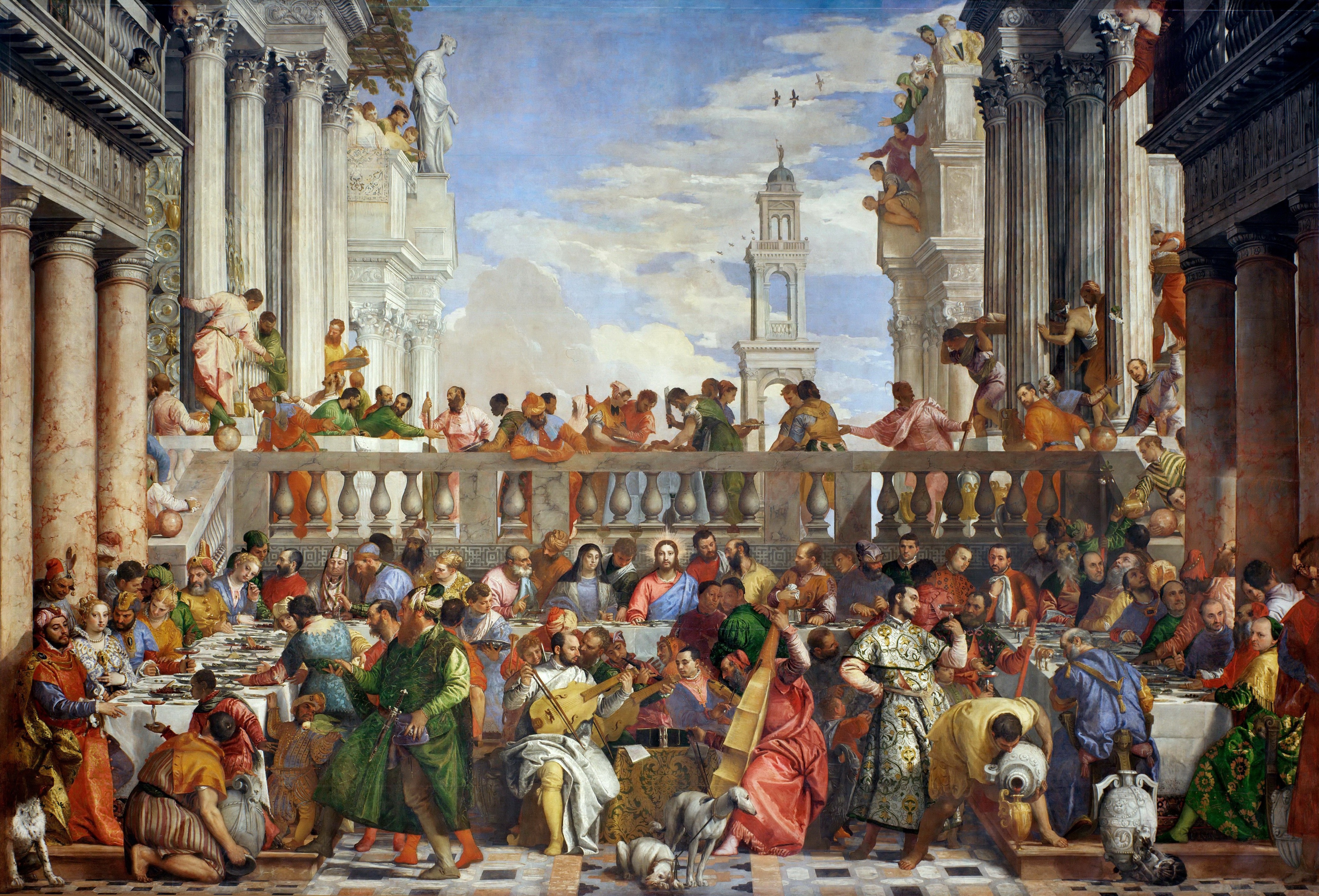
I ended up sticking with Western art simply because that’s what I’ve been able to find the most of. There are plenty of very cool Asian, Native American, South American and African art pieces with lots of detail and action, but it seems that expressive crowd scenes with high pixelation are the domain of European artists. Haven’t given up, though. Also, here's where art books from the library come in handy. Yay, libraries.

Veronese's Wedding at Cana. Thanks, Wikipedia.

There’s so much you can do. Here are a few ideas to start with:
  • Take turns describing what you see: observe details like colors, textures, light and shade, in addition to what is actually happening. 
  • Make up a title (best if you don’t show your student the title first). Make up titles for different parts of the scene if there is a lot going on. 
  • If you want, you can play a grammar game: list the verbs you see happening. List the nouns, and then the adjectives that describe them. List the adverbs. 
  • Describe imagined details: sounds, smells, sensations, tastes.
  • Make up a story about one person, about the whole scene...pick one interaction and tell what has happened just before the moment in the painting, and what will happen in the next moment(s). 


More on what to do with art coming soon.